The ( ناعورة Noria): Syria’s Historic Water Wheels of Hama
The norias are monuments of cultural identity.

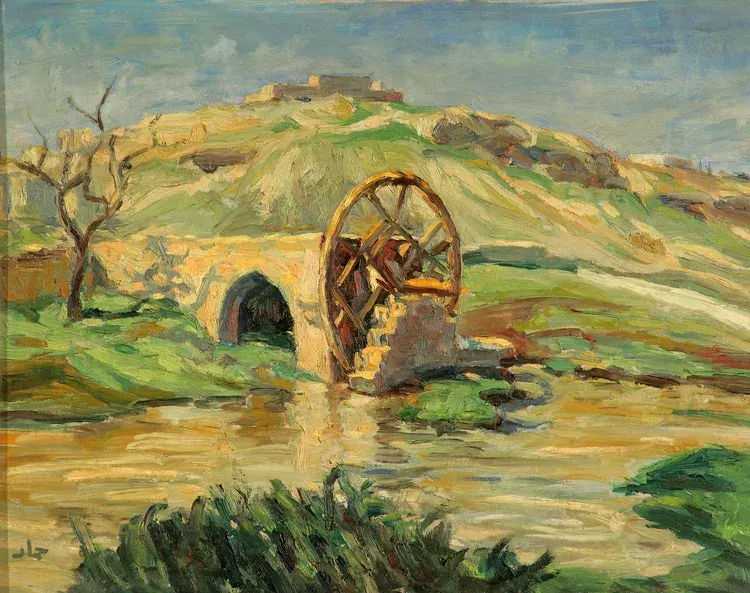
If you stood along the banks of the Orontes River in the Levant centuries ago, you wouldn't just see the towering architecture of irrigation; you would hear it. This unique sound was so deeply woven into daily life that it transcended engineering, embedding itself into local art, romance, and folklore. Generation after generation of poets and musicians looked at these massive machines and saw a reflection of their own inner lives.
Take, for instance, these haunting verses from a traditional Levantine folk song by the singer Ma'aen Dandashi
اسمعت عنين الناعورة عنينا شاغللي بالي
وهي عنينا عالمية وأنا عنيني عالغالي
أوووووف يابا يابا يابا
ناعورة عنينك زكرني بماضينا الحلو فكرني
ولأيمتا حيصبرني ياللي غيرو ما يحلالي
أوووف يابا يابا يابا
This is the English translation capturing its meaning:
Did you hear the groaning of the na‘ura? A groaning that occupies my mind.
Its eyes are fixed on the water, while my eyes are fixed on my precious one. Ooooh yaba yaba yaba... (Traditional vocal sigh)
Na‘ura, your groaning reminded me; it made me think of our sweet past.
How long will it keep me patient? The one who, without them, nothing feels right. Oooof yaba yaba yaba...
To the modern eye, a na‘ura is a relic of early hydraulic engineering, a brilliant solution to the problem of lifting water to high-altitude aqueducts. But to the people who lived beneath their shadows, the na‘ura was a companion in isolation, a witness to secret meetings on green meadows, and a symbol of perpetual longing.
Origins of the Noria in the Mediterranean
Water-lifting wheels have ancient roots, emerging as an ingenious solution to raise water for irrigation and daily use. The device known in Arabic as ( ناعورة na‘ura, or noria) is essentially a large undershot water wheel fitted with a series of containers or pots. Early versions of such wheels likely appeared in antiquity; they may have originated in the East (India or Egypt) centuries before spreading west. By the classical era, the concept was well known around the Mediterranean. The Roman engineer Vitruvius described water wheels with buckets in the 1st century BCE, and the poet Lucretius likened their ceaseless turning to the motion of celestial spheres. The very name "noria" comes from the Arabic "na'ura," meaning “the growler,” a reference to the distinctive groaning (عنين) hum these wooden wheels produce as they turn. Through trade and conquest, the design spread widely: by the 5th century CE, waterwheel norias were common in the eastern Mediterranean, and by the 11th century, they had been adopted in Islamic Spain (al-Andalus) and beyond. Medieval geographers noted their presence from Iran to Iberia: for example, around the year 1000, Al-Muqaddasi observed numerous norias (dūlāb, plural dawālīb) on the Karun (Ahvaz) River in Persia. In short, the na‘ura’s basic design (a wheel of pots powered by flowing water) became a global technology valued for its simplicity and effectiveness. Yet, as it travelled across continents, it remained deeply anchored in the soul of the Levant, where its rhythmic turning inspired generations of folklore.
The ناعورة (Noria) in Syria: From Apamea to Hama
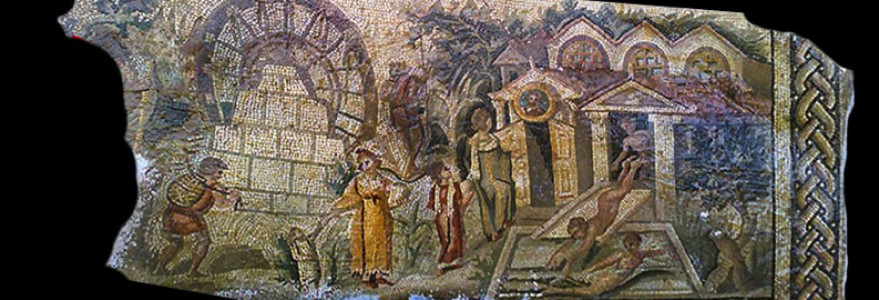
Syria embraced the na‘ura early on, thanks to its need for reliable irrigation in a seasonally dry climate. The first visual evidence of a na‘ura in Syria comes from a 5th-century Byzantine mosaic at Apamea (Afamia), which clearly depicts a waterwheel lifting water. This mosaic (dated 4th century AD) confirms that by late antiquity, large water wheels were already in use along the Orontes River. In fact, local conditions made the Orontes ideal for norias; the river’s gentle gradient and high banks meant that simple canals or shadufs couldn’t easily divert water onto the land, so lifting water by wheel was the most practical solution. After the 7th-century Islamic conquest of Syria, the new Arab rulers admired and adopted this technology, even giving the device its Arabic name. Medieval Islamic dynasties went on to refine and multiply the norias. By the 12th-13th centuries, Hama (a city straddling the Orontes) had become especially renowned for its norias. The Zengid ruler Nur al-Din famously rebuilt Hama’s water infrastructure after a 1157 earthquake, restoring and adding norias to ensure the city’s resilience.
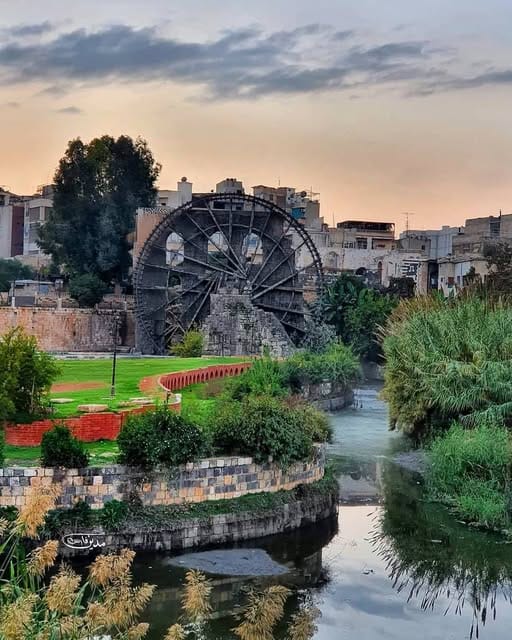
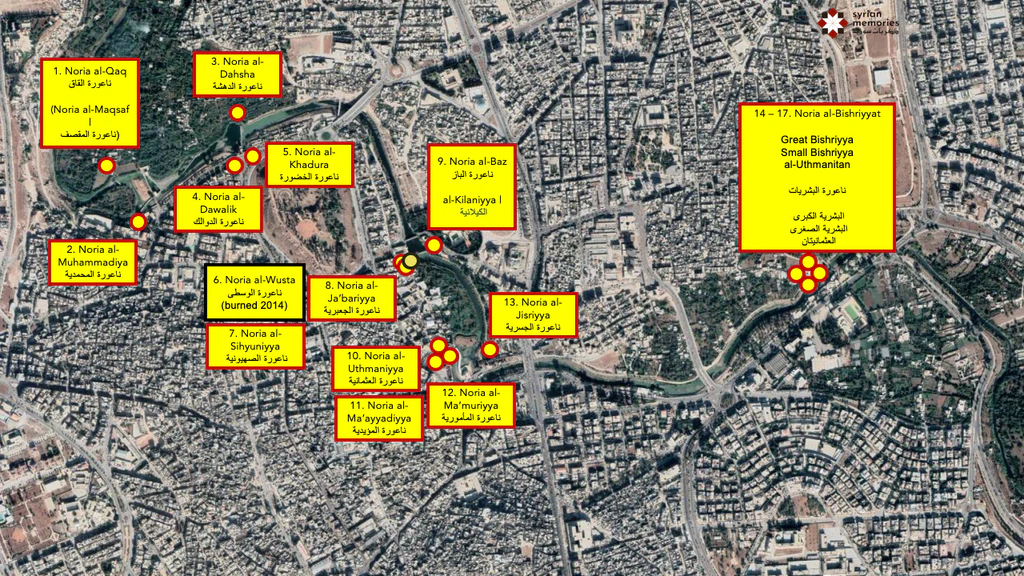
Over the ensuing centuries, Hama earned the nickname “City of the Norias” as dozens of these wooden wheels dotted the riverside. Travelers in the 13th century noted norias operating in Hama, and by the medieval period the city’s prosperity was closely tied to these machines. The largest norias were built under later dynasties: for example, the al-Muhammadiyya noria (built 1361 CE under the Mamluks) and alMa’muriyya (built 1453 CE under the early Ottomans) reached about 21 meters in diameter, giants of their time. These two massive wheels, inscribed with their dates and patrons, remained the world’s tallest waterwheels for nearly 500 years. By the pre-modern era, there may have been over a hundred norias in Hama alone; one local account claims 116 norias historically in the city and its environs and around 80 along the entire Orontes River basin. Hama’s norias lifted water to feed a network of aqueducts, nourishing both the city and its agricultural belt. Within a 2 km stretch of the river through Hama, 16 great wheels once operated, irrigating orchards on both banks and creating a broad green oasis along the river. Generations of Hama’s inhabitants grew up with the gentle roar of turning norias as a backdrop to daily life.
How a Noria Works: Design and Operation
At first glance, a noria is simply a very large water wheel, but its clever engineering lies in the way it lifts and delivers water. Each noria is an undershot wheel, meaning the current of the river pushes its paddles from below, with an array of container compartments (wooden boxes or clay pots) spaced around the rim. As the wheel rotates, these boxes dip into the river at the bottom, fill with water, and are carried up and over with the turning wheel. At the top of the rotation, each box aligns with a raised aqueduct trough, into which it pours out its water before descending empty again. The aqueduct (often a sturdy stone or brick channel) then conveys the water by gravity to where it’s needed, whether into irrigation canals, cisterns, or urban fountains. To enhance the wheel’s performance, small dams or weirs are usually built in front of it to direct a strong flow into the paddles, ensuring the wheel turns even when river levels are low. The entire system ingeniously uses the free energy of flowing water to perform the heavy lifting.
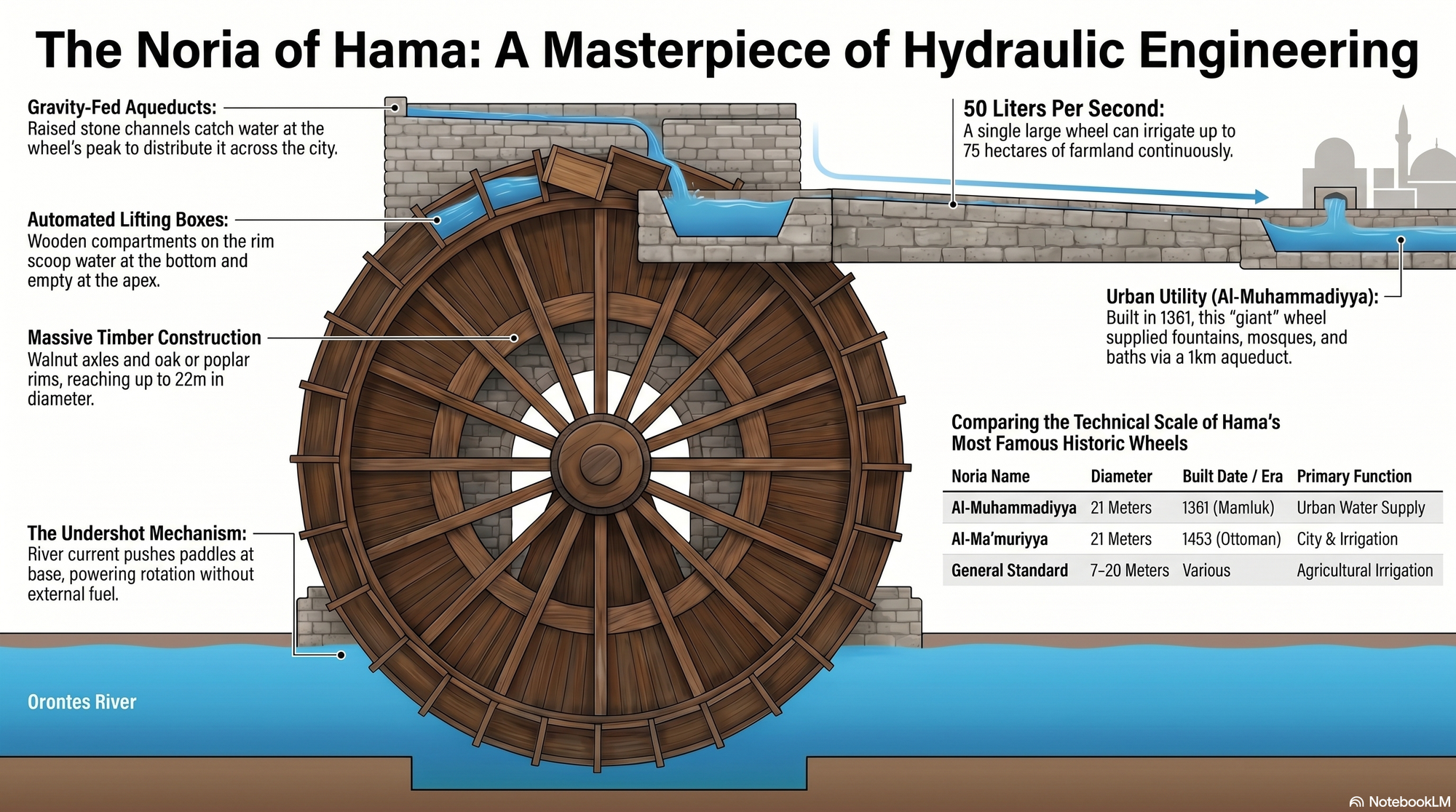
This made the noria invaluable in times and places where a dependable water supply meant the difference between barren land and fertile gardens.
Cultural and Symbolic Significance
Beyond their practical function, the norias of Hama hold deep cultural resonance. These towering wooden wheels, some as tall as a seven-story building, became iconic landmarks that defined the city’s identity. Hama is often affectionately called “the City of Norias,” and for good reason. The sight of multiple huge wheels slowly turning along the Orontes, their wet wood glistening in the sun and their reflections rippling in the river, has enchanted visitors for generations.
Early 20th-century travel writers waxed poetic about the atmosphere created by the norias. In 1923, the Tharaud brothers described Hama’s water wheels as if part of a dream, calling them “a poem melodically expressed with a simple musical instrument of love and carefreeness." To many locals, the droning of the norias was akin to music. It’s said that the old wheels “sing” as they work, and their song was part of Hama’s ambience, especially on quiet nights when the chorus of norias echoed over the riverbanks
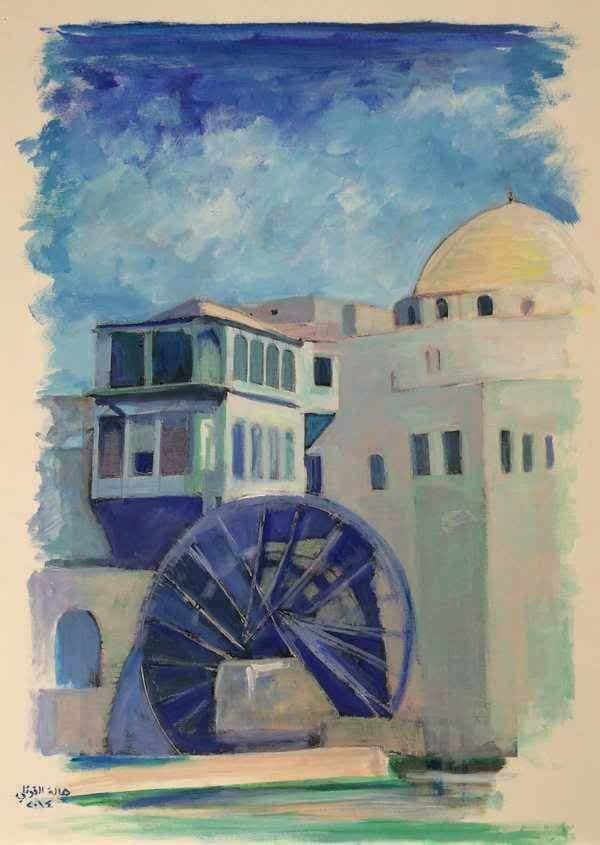
Architecturally, the wheels and their aqueducts added historic character to Hama’s urban landscape. Over time, the noria came to symbolize the ingenuity and heritage of Syrian engineering. Even in Syria’s modern national consciousness, Hama’s water wheels are treasured as a link to the country’s rich preindustrial past. In 2006, the oldest and grandest wheel, Noria al-Muhammadiya, was recognized as a Historic Mechanical Engineering Landmark by the American Society of Mechanical Engineers for its significance as a medieval technological achievement. There have even been efforts (unsuccessful so far) to nominate Hama’s norias as a UNESCO World Heritage Site, underlining their value not just to Syria but to human heritage.
Decline and Modern Status of the Norias
The age of the noria began to wane in the 20th century as newer technologies arrived. Starting in the 1930s, motorized water pumps powered by petrol and diesel gradually made inroads into Syrian agriculture. These pumps could draw water from rivers or wells year-round and on-demand, freeing farmers from depending on the river’s flow or maintaining large wooden machinery. The competition from pumps meant some norias were retired or fell into disrepair as enterprising landowners opted for the new engines. The decisive blow came in 1960 with the construction of the Rastan Dam upstream of Hama. The dam regulated the Orontes and significantly lowered the water level through Hama for much of the year. As a result, many of the big wheels could no longer reach the water during the dry season, leaving them idle for months. By 1970, only eight norias in Hama were still operational, down from around 20 noted a few decades earlier. Modern electric pumps had fully taken over the job of irrigation and municipal water supply.
Recognizing the cultural importance of the norias, local authorities and heritage organizations intervened to save what remained. In the late 1970s and 1980s, several norias were restored (rotted timbers were replaced, wheels rebalanced), and in some cases the riverbeds were dredged to allow the wheels to turn again. By 1988, restoration efforts peaked and a total of 17 norias had been rehabilitated in Hama. These restored wheels were no longer critical to water supply, but they were made to rotate and lift water for posterity (albeit often just recirculating it back to the river shortly after, as many aqueducts now stop a short distance from the wheel). Through decades of change, the norias remained the beloved symbol of Hama, a status they retain to this day.
The outbreak of war in Syria in 2011 raised fears for the fate of Hama’s historic norias. Most of the 17 heritage norias survived the war intact, though the turbulence did have some impacts; in 2014, one Noria al-Wusta (The Middle Noria) caught fire (reportedly due to arson) and was partially charred. The biggest challenge post-war has been the loss of skilled craftsmen and resources to maintain the aging wooden structures. By 2020, local initiatives and volunteers stepped in, trying to patch up and preserve the wheels.
Preservationists continue to seek ways to maintain these structures for future generations, not only as tourist attractions but also as educational examples of sustainable water technology. The noria represents a clever synergy between nature and human need: a machine powered only by the flow of water, which in turn gives life to the land. In an era when modern pumps and dams have long taken over, Hama’s surviving norias spin (even if only occasionally) as monuments of history.
When we listen to the traditional mawwal crying out, "Did you hear the groaning of the waterwheel? A groaning that occupies my mind," we are not just listening to a love song. We are listening to a historical echo.
The physical wooden structures may slowly succumb to time, but the "groan" of the noria; that beautiful, melancholy friction between human ingenuity and the natural world; continues to turn perpetually in the music, the art, and the heart of the region.