Reassessing the Drought–Migration–Conflict Nexus in Syria

A 2025 UNU-INWEH report entitled “The Drought-Migration-Conflict Nexus: Was the Syrian Civil War Really Caused by Climate Change?” provides a comprehensive reexamination of the commonly held narrative linking Syria’s 2007-2009 drought to the 2011 uprising.
Summary of UNU - INWEH Findings
The study employs a mixed-methods approach (meteorological analysis, satellite-based landuse data, and field interviews with displaced Syrian farmers in Türkiye) to trace how climate stress intersected with socioeconomic and governance factors. Crucially, the report finds no simple cause-effect chain from drought to war. Instead, evidence shows only limited drought-driven farmland abandonment, with cropland activity largely sustained up to the eve of the conflict, suggesting that rural decline and migratory pressures were underway well before the drought and were later exacerbated by the war rather than caused by climate stress alone.


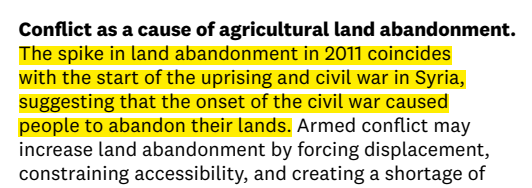
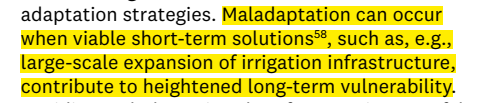
The key findings challenge the popular “climate war” story line that a record drought directly sparked Syria’s revolt. While the 2007-2009 drought was indeed severe, its impacts unfolded in a context of long-standing mismanagement and vulnerability. According to the UNU-INWEH report, around 19% of Syria’s cropland was abandoned between 2001 and 2016, reflecting a structural agricultural collapse that began well before the drought years. This collapse is attributed to years of maladaptive policies: for example, a rapid expansion of water intensive crops (like wheat and cotton) under heavy irrigation, followed by abrupt subsidy removals in 2008-2009 that “eroded farmers’ resilience and amplified vulnerability to drought”.

The study’s satellite imagery analysis reveals that the agricultural sector actually rebounded quickly after the drought, reaching a near-record high of cropland cultivation in 2010 (about 90% of all arable land). This rebound in 2010, just one year before the conflict, contradicts the notion of an irreversible drought-induced agricultural collapse. However, the apparent recovery “masked a deep fracture between ‘winners and losers"": areas with government-supported irrigation thrived, while smallholders in rain-fed regions (especially Syria’s northeastern breadbasket) were hit by a “perfect storm” when fuel and fertilizer subsidies were lifted, tripling diesel prices and crippling their ability to irrigate.
Migration patterns documented in the report further debunk the oversimplified drought-to-mass departure of people story. Pre-war migration in rural Syria is shown to have been largely internal, seasonal, and economically motivated; essentially a traditional coping mechanism even in normal years. “We found that migration before the war was a common adaptation strategy among rural residents, even during years with no drought. Blaming the lack of rain ignores the political decisions that stripped farmers of their safety nets,” explains Dr. Lina Eklund, the report’s lead author. In other words, many farming families periodically moved in search of work long before 2011, due to structural rural poverty and underdevelopment, not simply because of a single dry spell. Only after the war’s outbreak in 2011 did migration patterns shift to large-scale, forced displacement, as violence drove Syrians out of their home regions entirely. The conflict, rather than the prior drought, ultimately caused the mass migration (including millions of refugees) by destroying infrastructure and security in rural areas.
Overall, the UNU-INWEH report paints a complex picture of the drought-migration-conflict nexus. It underscores the primacy of governance failures and unsustainable development practices in rendering Syria vulnerable. Decades of state policy encouraging water-intensive agriculture led to aquifer depletion and soil degradation; a man-made or “socioeconomic drought” that persisted even after rains return. When the 2007-2009 drought struck, it acted as one additional stressor on an already-fragile system. The situation was compounded by an abrupt shift toward a market-oriented economy (Syria’s late-2000s “social market” reforms) which slashed rural subsidies and safety nets, leaving farmers with “no financial buffer against climatic shocks”. Rather than finger-pointing at climate alone, the report concludes that the war itself became the decisive driver of displacement and rural livelihood collapse, locking in the damage that mismanagement and drought had set in motion. In short, climate stress interacted with and amplified existing vulnerabilities, but did not initiate Syria’s conflict.

Critical Evaluation of Evidence and Methodology
The UNU-INWEH study’s methodology marks a rigorous attempt to untangle climate influences from other factors in Syria’s crisis. By combining quantitative data (rainfall records, drought indices, satellite observations of land use) with qualitative insights (interviews with Syrian farmers who experienced the drought and its aftermath), the researchers sought a holistic understanding of causality. This approach is a strength: earlier narratives were often based on anecdotal reports or assumed links, whereas here remote-sensing evidence objectively maps changes in cultivation and abandonment over time. The finding that only 19% of cropland was abandoned from 2001-2016 is backed by satellite analysis, lending credibility to the claim that a wholesale collapse of farming due to drought did not occur. In fact, the satellite data showing extensive cultivation in 2010 (post-drought) is a striking piece of evidence that “contrary to the ‘collapse’ narrative, the agricultural sector was surprisingly resilient” before the war. This resilience, however, is interpreted in context-the report’s nuance lies in showing that apparent recovery masked inequities (large irrigated farms prospering while small rain-fed farms struggled). By correlating policy changes (like subsidy cuts) with the timing of rural hardships, the study provides a persuasive causal story: policy choices and resource mismanagement primed the crisis, while the drought was the spark in a powder keg.

Interview-based evidence also strengthens the analysis. Direct accounts from Syrian farmers (now refugees in Turkey) illuminate how rural communities coped with drought and how they perceive the causes of their displacement. These testimonies support the idea that migration was often a deliberate livelihood strategy (e.g. seasonal work in cities) rather than a panicked flight from drought, until war made conditions unlivable. Such qualitative data adds depth to the satellite findings, ensuring the report does not misread continued cropland activity as meaning all was well (farmers might continue farming under duress or inequality). The mixed-methods design thus helps distinguish between land still being farmed (which might be due to wealthier or luckier farmers) and smallholders who had to leave. Indeed, the report’s discussion of “winners and losers” acknowledges that continued agricultural output in aggregate coexisted with deepening rural impoverishment for many. This balanced interpretation is a testament to the study’s methodological carefulness.
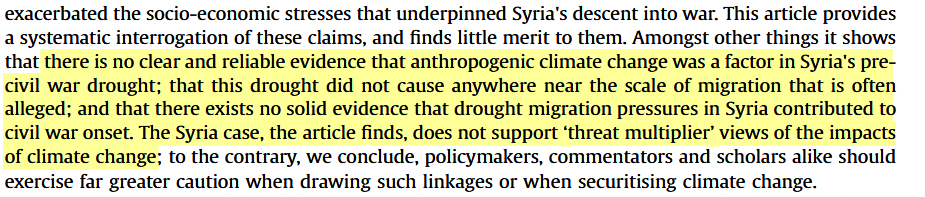
Attribution of causality in a complex socio- environmental system is inherently challenging. While Selby et al. (2017), which the report cites and synthesizes, argue that there is "no clear and reliable evidence that anthropogenic climate change was a factor in Syria's pre-war drought" and that "this drought did not cause anywhere near the scale of migration that is often alleged", the report does rely on meteorological data that show the drought’s severity. One could ask whether the study fully untangled the role of external climate trends. For example, did it perform climate model attribution to assess if greenhouse warming made the 2007-2009 drought more likely? Despite using SPI (Standardized Precipitation Index) and SPEI (Standardized Precipitation Evapotranspiration Index), they are not sufficient on their own to fully untangle the role of external climate trends, especially in attributing drought events to anthropogenic climate change. In fact, they fall short for attribution to climate change. The UNU-INWEH report seems to emphasize impacts over meteorological attribution, so it largely accepts the drought as a given reality and focuses on the socioeconomic response. This is appropriate for the question at hand (conflict causation), though it leaves open the climate change question. Moreover, the use of satellite data provides robust indicators of cultivated land, but it may not capture subtler socioeconomic stress. For instance, fields might have been replanted by 2010, yet farmers’ debts or loss of livestock from the drought could still have caused hardship. The report’s focus is largely on cropland extent, not crop yield or income, which could be a gap; a near-normal area under cultivation in 2010 does not guarantee that rural households were fully recovered financially.
Another consideration is the use of proxy data for migration. The report infers migration patterns from interviews and possibly census data, but precise figures (e.g. whether “drought migrants” moved to cities, as often claimed) are hard to verify. The authors contend that drought-related migration was smaller than commonly reported, aligning with other scholarship, but this could be further quantified. Additionally, we might argue that the causal weight of the drought isn’t fully quantified here; for example, how many people did the drought push into cities temporarily, and did that have any influence on unrest? The report asserts those migrations were routine and reversible, which is plausible, though perhaps more interview data on migrants’ experiences could further substantiate this point.
Sampling bias in interviews (talking mainly to those who left Syria) might also shape the findings, the narrative of adaptive, temporary migration pre-war comes from those individuals’ experiences, which might differ from those who stayed behind. Despite these caveats, the methodology is robust in triangulating multiple evidence streams, and it significantly improves our empirical basis for judging the drought’s role. Additionally, interviewing refugees years after the fact (often recalling conditions under both drought and war) could introduce recall bias. The sample of farmers interviewed (those who ended up in Türkiye) might over-represent people whose lives were ultimately uprooted by conflict, possibly under-representing those who managed to adapt in place. It is worth mentioning that these remaining uncertainties (e.g. exact migration numbers attributable to drought vs. other drivers) are acknowledged in the report’s narrative by emphasizing complexity over any single cause.

Notably, the UNU-INWEH findings reinforce arguments made by some earlier experts while challenging others. The emphasis on governance failures, unsustainable farming, and ill-timed economic reforms echoes what analysts of Syrian agriculture have long warned. By quantifying land-use change, the report gives weight to the claim that mismanagement and policy shocks, such as the subsidy cut that “tripled the cost of irrigation diesel overnight”, dealt the real blows to farmers’ livelihoods. The concept of a prolonged “socioeconomic drought” caused by over extraction of water (even when rainfall recovered) is particularly insightful. It suggests that the true “drought” was as much human-made as climate-made, an insight with methodological implications: one must measure not just rainfall, but also groundwater levels, farming practices, and rural incomes to grasp the full picture. The report’s critical stance toward simplistic climate-conflict narratives is grounded in evidence yet stops short of dismissing climate influence entirely. In sum, the study’s approach and evidence are compelling and represent a sophisticated analysis of the drought-migration-conflict nexus. It provides a more credible explanation for Syria’s rural crisis than the popular one-factor story, though like all case studies of complex conflicts, some uncertainty remains.
Contrasting Views and Climate-Conflict Scholarship
The question of whether climate change contributed to or caused the Syrian war has been hotly debated in academic, policy, and media circles. The UNU-INWEH report enters this debate clearly on the side of nuance and skepticism toward a mono-causal “climate war” explanation, and it aligns with several scholars who challenge the climate- conflict hypothesis. However, it also runs against a wave of earlier research and commentary that did find a significant climate link. To contextualize the UNU-INWEH findings, it’s essential to compare them with key studies and viewpoints on both sides of this debate.
Proponents of the climate-conflict link often cite the 2007 - 2010 drought as an initial domino in Syria’s collapse. A landmark study by Kelley et al. (2015) in PNAS examined the drought’s climatological origins and its social aftermath. Kelley and colleagues concluded that anthropogenic climate change had likely doubled or tripled the probability of a drought as severe as the one that hit Syria. They noted a long-term drying and warming trend in the Eastern Mediterranean, consistent with greenhouse gas forcing, and found “the unusual severity of the observed drought is highly unlikely without this [climate] trend”. In their assessment, climate change was a stress multiplier that, combined with poor water management, “crippled agricultural production in Syria,” leading to the displacement of farming families. However, they still weave those factors into a chain where the drought is the spark that ignites the tinder of existing grievances
drought ⇒ crop failure ⇒ mass migration from rural northeast to urban areas ⇒ social unrest.
In this narrative, the drought’s timing and impact were pivotal; it pushed Syria over a threshold of instability that tipped into revolt
Indeed, they estimated up to 1–1.5 million people were uprooted by drought and resource failure, moving into Syria’s cities just before the uprising. “The rapidly growing urban peripheries of Syria, marked by illegal settlements, overcrowding, poor infrastructure, unemployment, and crime, were neglected by the Assad government and became the heart of the developing unrest,” Kelley wrote.
In this view, the drought-induced migration worsened pre-existing urban problems (joblessness, corruption, inequality), helping to spark the 2011 revolt. Kelley et al. (2015) acknowledged that the Syrian conflict has no single cause, “civil unrest can never have a simple or unique cause”, but they maintained that climate change likely made the drought worse and thus contributed to the conflict. They explicitly mapped “connected pathways to the Syrian conflict, from human interference with climate, to severe drought, to agricultural collapse and mass human migration”, alongside the government’s failures in managing those stresses. This influential study gave scientific credence to labeling Syria as “the first climate war,” a phrase that caught on in media and policy discussions.
Other experts and policymakers echoed this climate-conflict hypothesis. Peter Gleick (2014), for instance, wrote that “drought, exacerbated by climate change, and water mismanagement contributed to the conflict in Syria,” highlighting how water scarcity can ignite existing tensions.
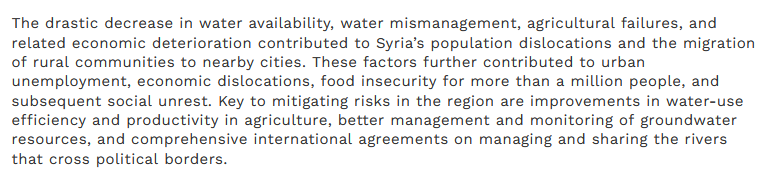
High-profile commentators like Thomas Friedman also amplified the narrative. In early 2015, Friedman argued that “the little-understood reason for the "civil" war in Syria was the 2006-2010 drought that forced 1 million people to abandon their unproductive farms and move to overcrowded cities”, where “resentment grew over the government’s failure to respond”. He quoted Syrians calling the uprising “a revolution of freedom and a revolution of the hungry,” explicitly tying environmental stress to the social unrest.

The “climate as catalyst” idea was thus well-publicized: it appeared in U.S. government analyses describing climate change as a “threat multiplier” for instability, in think-tank reports (e.g. The Arab Spring and Climate Change, 2013) and in media outlets from the New York Times to the BBC. For example, "The Ominous Story of Syria's Climate Refugees," framed the crisis as a warning about the future of a warming planet. Such representations were bolstered by the scientific findings of Kelley et al. (2015) and others, which seemed to offer a straightforward cause-and-effect. Major global institutions also weighed in; even the IPCC (Intergovernmental Panel on Climate Change) cited conflict risk in the context of climate impacts (albeit with caution), and security agencies began including Syria’s drought in reports on climate-driven unrest. In summary, the supporting camp posits that climate change did play a material role in Syria’s descent into war ; not as the sole cause, but as a significant aggravating factor that pushed an already simmering situation over the brink.
The Kelley et al. (2015) paper alone yielded significant media attention, being cited over 1,300 times and forming the basis for many news reports.
On the other side of the debate, scholars have challenged or refined the climate-conflict hypothesis in the Syrian case. Critics argue that attributing the civil war to climate change or even to drought is an oversimplification that ignores political, economic, and historical drivers. One of the earliest skeptical voices was Francesca de Châtel (2014), whose extensive field research led her to conclude that “it was not the drought per se, but rather the government’s failure to respond to the ensuing humanitarian crisis that formed one of the triggers of the uprising, feeding discontent that had long been simmering in rural areas.” She describes Syria’s predicament as “the culmination of 50 years of sustained mismanagement of water and land resources” ; a result of over-expanding irrigated agriculture, overgrazing, and ill-conceived economic policies that “blinded policymakers to the limits of the country’s resources”.

In her view, the drought was the “final straw” on an already weakened system, and focusing too much on climate would “divert attention away from the core problem: the long-term mismanagement of natural resources”. De Châtel even cautioned that an “exaggerated focus on climate change” can become an “unhelpful distraction”; or worse, a narrative that “allows the Assad regime to blame external factors for its own failures.” This perspective closely mirrors the UNU-INWEH findings: both point to governance and policy failures as the primary causes of Syria’s rural collapse, with climate variability as a contributory but not determinative factor.

The most comprehensive refutation of the climate-conflict thesis came from Jan Selby and co-authors (2017), who conducted a systematic review of the evidence. Their article “Climate change and the Syrian civil war revisited” finds “little merit” in the claimed causal links. Selby et al. (2017) argue, point by point, that: (1) there is “no clear and reliable evidence” that anthropogenic climate change was to blame for the 2006-2009 drought (they note that Syria has a history of recurring droughts and that attributing one event to climate change is very weak); (2) the drought did not cause mass migration on the scale often reported; rural populations were under stress, but the oft-cited figure of one million or more drought refugees moving to cities is not supported by data; and (3) there is “no solid evidence” that any drought-related migration that did occur actually contributed to the conflict’s outbreak. In short, they conclude that the Syrian case does not validate the idea of climate change as a significant “threat multiplier” for war, and they urge analysts and policymakers to “exercise far greater caution” when drawing such linkages or securitizing climate issues.
This hard-hitting critique sparked a scholarly exchange: proponents of the climate-conflict link (including Kelley) published rejoinders defending their interpretations, while Selby penned a follow-up piece reinforcing his skepticism. The debate underscores that correlation is not causation; just because drought and unrest coincided does not mean one caused the other, a point Selby’s camp emphasizes with alternative data and interpretations. Other studies have added nuance. For example, some research suggests that conflict itself has worsened Syria’s environmental conditions (a “conflict trap” making future climate impacts even more damaging), while others note Syria is often cherry-picked as a case in climate-security research due to its high profile. Yet, overall, the weight of recent scholarship leans toward a more qualified view: climate stress likely exacerbated Syria’s problems, but governance, demographic pressures, and political grievances were the decisive factors in the eruption of war.
By comparing these views, in my opinion, there is a spectrum of interpretations. On one end, Syria’s war is held up as a cautionary tale of climate change contributing to conflict, supported by climatic data and dramatic narratives of drought-driven migration. On the other end, Syria is held as a cautionary tale against jumping to climate determinism, emphasizing mismanagement and the danger of letting governments off the hook for their own failures. There is also a middle ground: even skeptics like de Châtel acknowledge that climate change may have acted as a “threat multiplier” ; i.e., intensifying an existing drought; but they insist this is of secondary importance to how Syria’s government prepared for and responded to that drought.
Many analysts now adopt this “yes, but” position: yes, climate change likely worsened the drought, but the war’s causes lie in human factors (poor water governance, economic inequality, repression, etc.).
This balanced view is essentially what the UNU-INWEH report advances: climate stress is part of the story, but not the plot. In Professor Kaveh Madani’s words (Director of UNU-INWEH), labeling complex crises simply as climate wars “lets bad governance off the hook” and risks “reductionist narratives” that obscure the true causal web. A sole focus on climate, he warns, misses the “complex causal relationships” needed to understand instability and “who gets water and who goes thirsty”.
Synthesis and Conclusion
Drawing together the UNU-INWEH findings and the broader scholarly discourse, a clearer picture emerges of the role of climate in Syria’s tragedy. The evidence indicates that Syria’s war was not caused by climate change in any direct or singular sense. The 2011 conflict stemmed from a confluence of political, social, and economic grievances that had accumulated over decades; mismanagement, rural neglect, corruption, population pressures, and the sudden shocks of economic liberalization. The 2007-2009 drought was indeed an added stressor, and climate change likely increased the drought’s severity, but by itself this drought was neither unprecedented enough nor impactful enough to unleash conflict without the context of state failures.
In conclusion, the Syrian drought-migration-conflict saga is a cautionary tale against one dimensional explanations. The new UNU-INWEH analysis refutes the idea that Syria’s war was simply the first modern “climate war.” Instead, the Syrian conflict should be seen as a complex tragedy in which climate change played a supporting role, not a lead actor. The core drivers were internal and man-made; policies and politics that left a society incapable of withstanding shocks. Climate change did add pressure, and in the future such pressures will grow, but whether they translate into conflict depends on how societies handle them. The debate around Syria has enriched the climate-security field by highlighting both viewpoints: those who see an ominous link and those who urge caution. The synthesis of these views suggests a middle path: climate change can heighten risks of instability, but its effects are mediated by governance, adaptation, and resilience on the ground. Syria exemplifies how not to manage these stresses.
Moving forward, the lesson learned is that sound water and agricultural governance, conflict-sensitive adaptation policies, and socioeconomic reforms are critical to prevent future droughts, however severe, from spiraling into social upheaval. Climate change is redefining baseline conditions (e.g. making droughts more likely), but the outcomes will be determined by human choices. In the end, Syria’s experience underscores that human insecurity in the face of climate stress is fundamentally a governance and development problem, with climate change being the dangerous backdrop rather than the sole scriptwriter of conflict.