The Penguin Who Walked the Wrong Way

I am not sure whether it has appeared on your social media feed recently, but a muted, black-and-white video of a penguin has been circulating with unusual persistence. It is the kind of footage that provokes an involuntary reaction; a brief tightening of the face, a pause; drawing you into empathy before you have time to name the emotion.
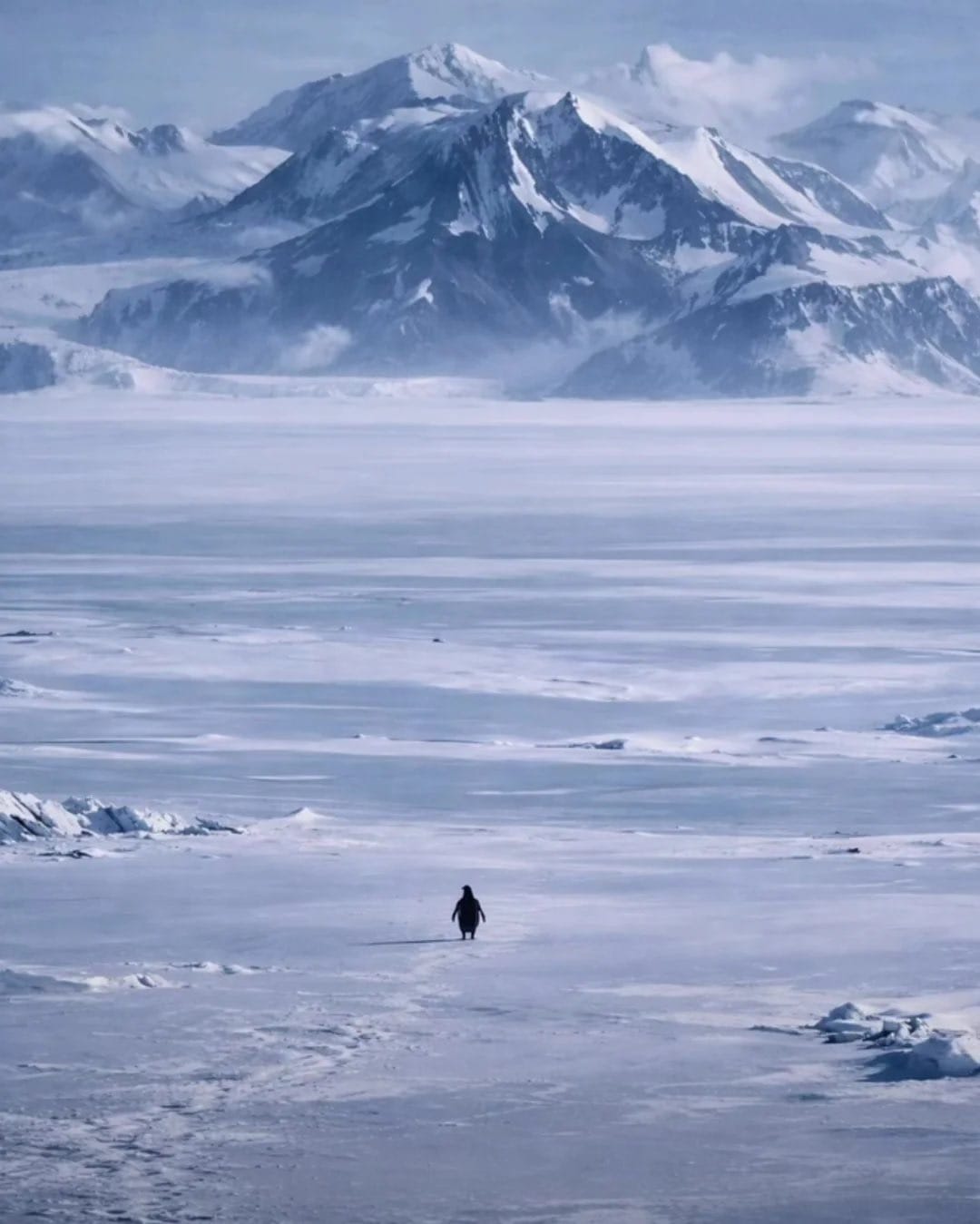
A line of penguins moves steadily toward the sea, toward nourishment, toward continuation. Then one breaks formation. It stops, turns without apparent doubt, and heads inland, toward the vast ice and the mountains of Antarctica. The clip is brief and nearly soundless, yet it lingers, leaving an unease that resists simple interpretation.
Online, the penguin has already been assigned an identity: "the nihilist penguin" or “the depressed penguin,” With time, the clip ceased to function as mere content and began to operate as a symbol; one that many now describe as emblematic of a broader generational return.
When scientists analyze the penguin’s behavior, their interpretations remain technical and affectively neutral. They refer to spatial disorientation, to a malfunction in instinctual navigation. In the now widely cited moment from the footage, researchers carefully lift the penguin and return it to the edge of its group. Almost immediately, it pivots and resumes its path toward the mountains. From a scientific standpoint, this is categorized as a neurological misfire: the animal’s internal compass is misaligned, directing it not toward the sea, but decisively away from survival.
In Antarctica, that direction is not symbolic. It is terminal. And yet the footage spread, accelerated by algorithms and human unease, until the question hardened into a chorus: Why?
Why did it leave?
Why would it choose a path that leads to death?
Lines like “the penguin knows” and “heading toward oblivion” started circulating, as if the animal had posted a status update and we were decoding it.
What struck me was not the penguin’s movement, but our reaction to it. We could not let the act stand as it was. We needed a cause, a trigger, a story that made the trajectory intelligible. Illness. Disorientation. Climate change. Magnetic fields. Anything that would convert natural act into reason.
Because this natural behavior unsettles us.
We are deeply uncomfortable with events that refuse meaning. A penguin walking the wrong way threatens a quiet assumption we hold about nature; that it is orderly, rational, and aligned with survival. When it is not, we rush to repair the breach with explanation. We search for comfort in causality, even speculative causality, because accepting that some things happen without a decipherable why feels intolerable.
But perhaps the more revealing question is not why the penguin walked toward the mountains, but why we cannot accept that it might have done so without a narrative that redeems the act.
The fixation is telling.
The act itself is natural. Animals misorient, instincts fail, not every movement in nature carries intention or symbolism. And yet, we refuse to let this moment remain unframed. We dissect it, diagnose it, aestheticize it. We assign it meaning because a natural act without explanation feels unacceptable in a world trained to believe that every deviation must have a reason.
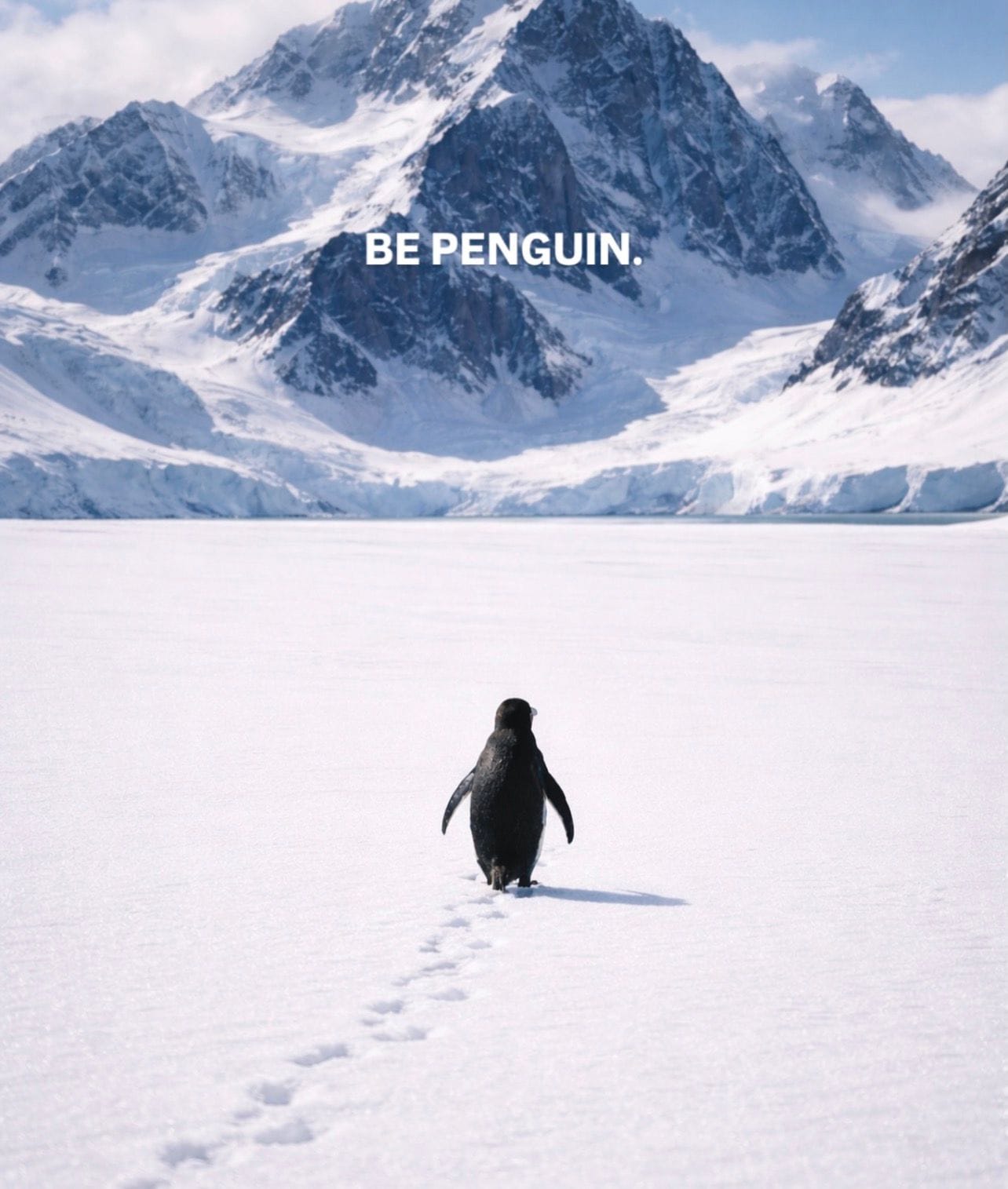
What transformed this clip into something viral was not the penguin, but the projection placed upon it. Every frame became trigger material: solitude rebranded as bravery, separation mistaken for clarity, walking alone romanticized as moral strength. Algorithms favor this reading. Content that celebrates isolation, individual rupture, and dramatic self-exile travels faster than images of quiet cohesion.
Loneliness is framed as depth.
Departure is framed as courage.
But nature tells a less flattering truth.
The penguin that walks alone does not become enlightened. It dies.
There is a dangerous oversimplification embedded in how we consume this clip today: the idea that leaving is always virtuous, that standing apart is inherently ethical, that belonging is suspicious, and loyalty is a disease. We are repeatedly told (explicitly and implicitly) if your group does not align with your values, leave. And while there are moments when departure is necessary, the algorithm rarely finishes the sentence.
Leaving without belonging elsewhere is not freedom. It is exposure.
In the wild, survival is collective. Direction is shared. Correction happens through proximity. The penguin was not saved by insight; it was saved, briefly, by being returned to the group. When it walked away again, it was not making a statement. It was malfunctioning.
Perhaps the discomfort this clip provokes comes from what it quietly contradicts. Not every act of separation is brave. Not every form of solitude is wisdom. And not every group is disposable simply because it is imperfect.
If a group violates your morals, leave; but do not romanticize being alone. Seek another formation. Another alignment. Another collective. Because isolation, however poetic it appears on screen, is not neutral.
We asked why because we needed reassurance that the world is still legible.
And perhaps the hardest answer is this: sometimes it is not.
In Antarctica, walking alone toward the mountains is fatal.
And in life, it often is too.