Old Doha Port: Water, Pearls, and Heritage

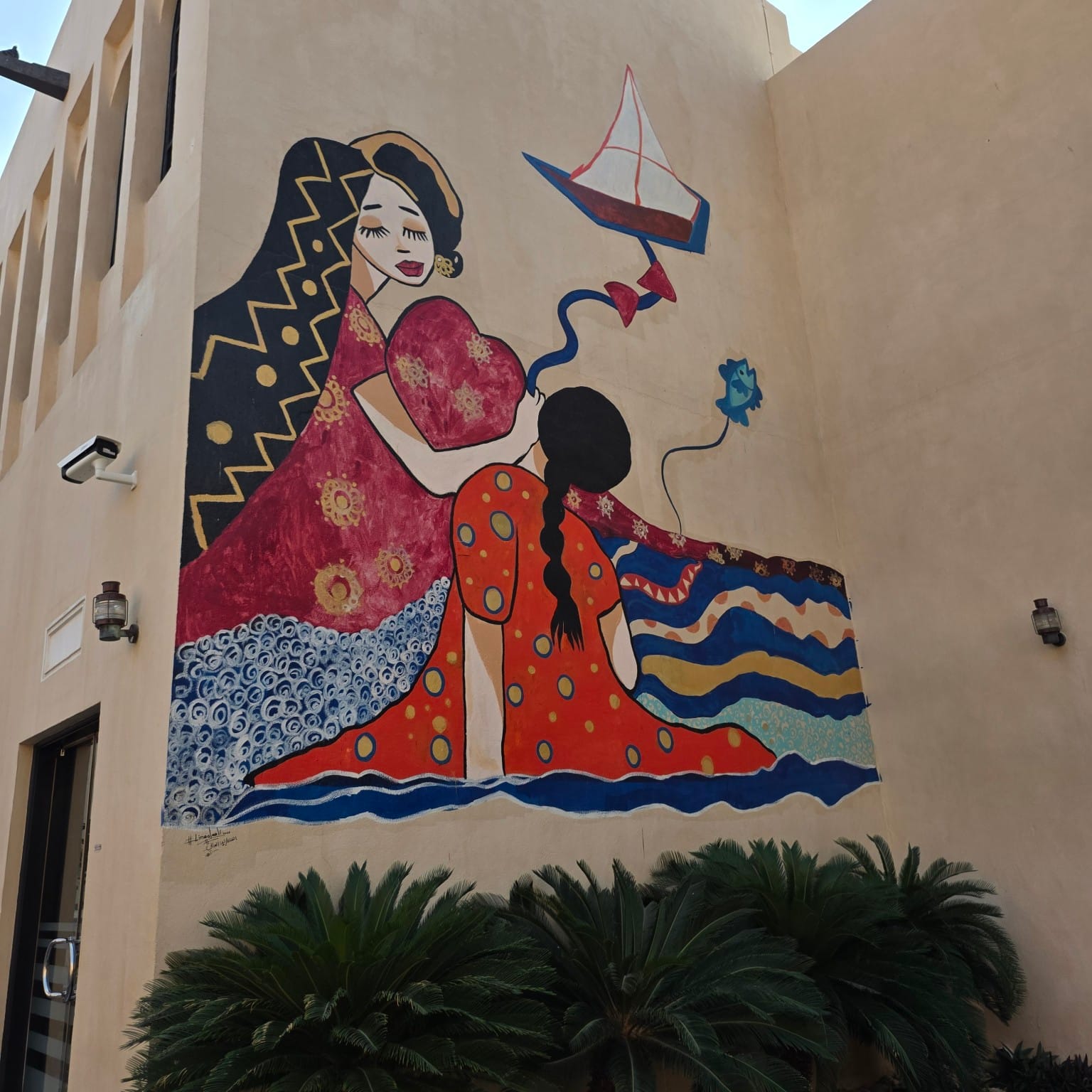
In Mina’s pastel - coloured streets, water does not just appear as horizon and reflection, it is present as inheritance and imagination. The murals that colour these waterfront walls do not merely decorate: they speak to a continuity of life that once braced itself against the tides and still draws meaning from them. In one such mural I saw in Katara cultural village of Doha, a girl sits facing the sea with a ship-shaped kite, while another holds a fish-kite; a quiet testament to heritage and possibility. It is impossible to see this image without reading it through water. The boat-shaped kite carries the memory of the port itself: dhows leaving the shore, pearl divers disappearing beyond the horizon, trade routes etched into the Gulf long before Mina had a name. It speaks of movement, risk, and return. The fish-shaped kite speaks differently. It is about sustenance, intimacy, the daily relationship with the sea as provider rather than passage.
This is Mina’s story.
This image captures the essence of the Old Doha Port (today’s Mina District) where sea and memory meet. Here, the water becomes a storyteller, and people are both listeners and narrators.
The Port That Remembered Its Water
At the heart of Doha’s glittering skyline lies the Mina District, a nostalgic re-creation of the city’s first harbor. Doha’s story began by the water, a reality still echoed in local lore. Long before Mina became a destination for dining, shopping, and art, this same harbour was the lifeblood of local communities. Even when Doha was only a small fishing village, the port served as a trading centre; a place where boats brought grains and goods from India, Iran, and beyond, and local catch and pearls helped keep markets and homes alive.
It was here that men and women knew every nuance of the tide; where the rise and fall of water shaped when dhows set off for fishing and pearling and how families arranged their days around the sea’s rhythms. Mina was not just a maritime hub, it was a home of movement and stillness alike — a junction between shoreward roots and seafaring futures.
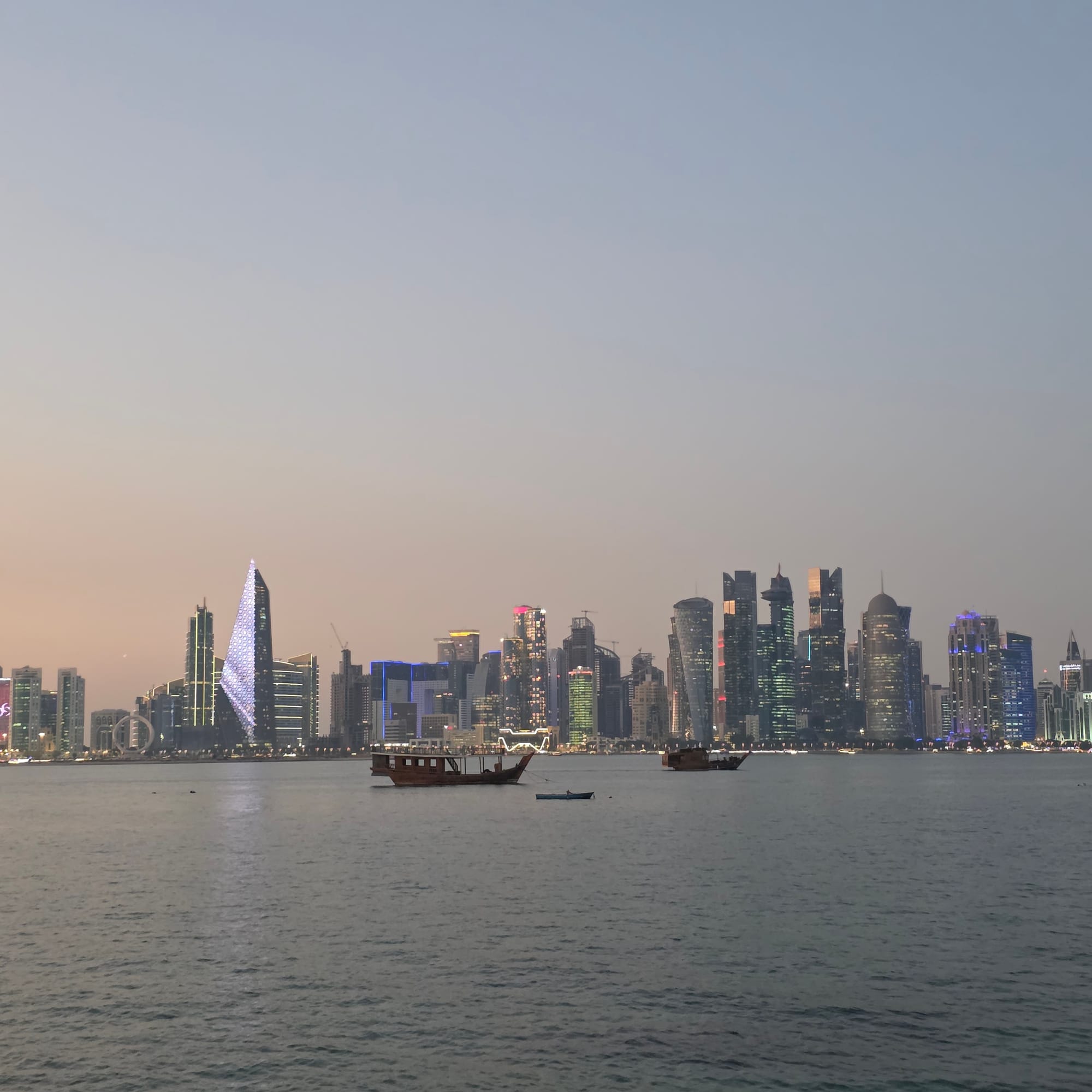
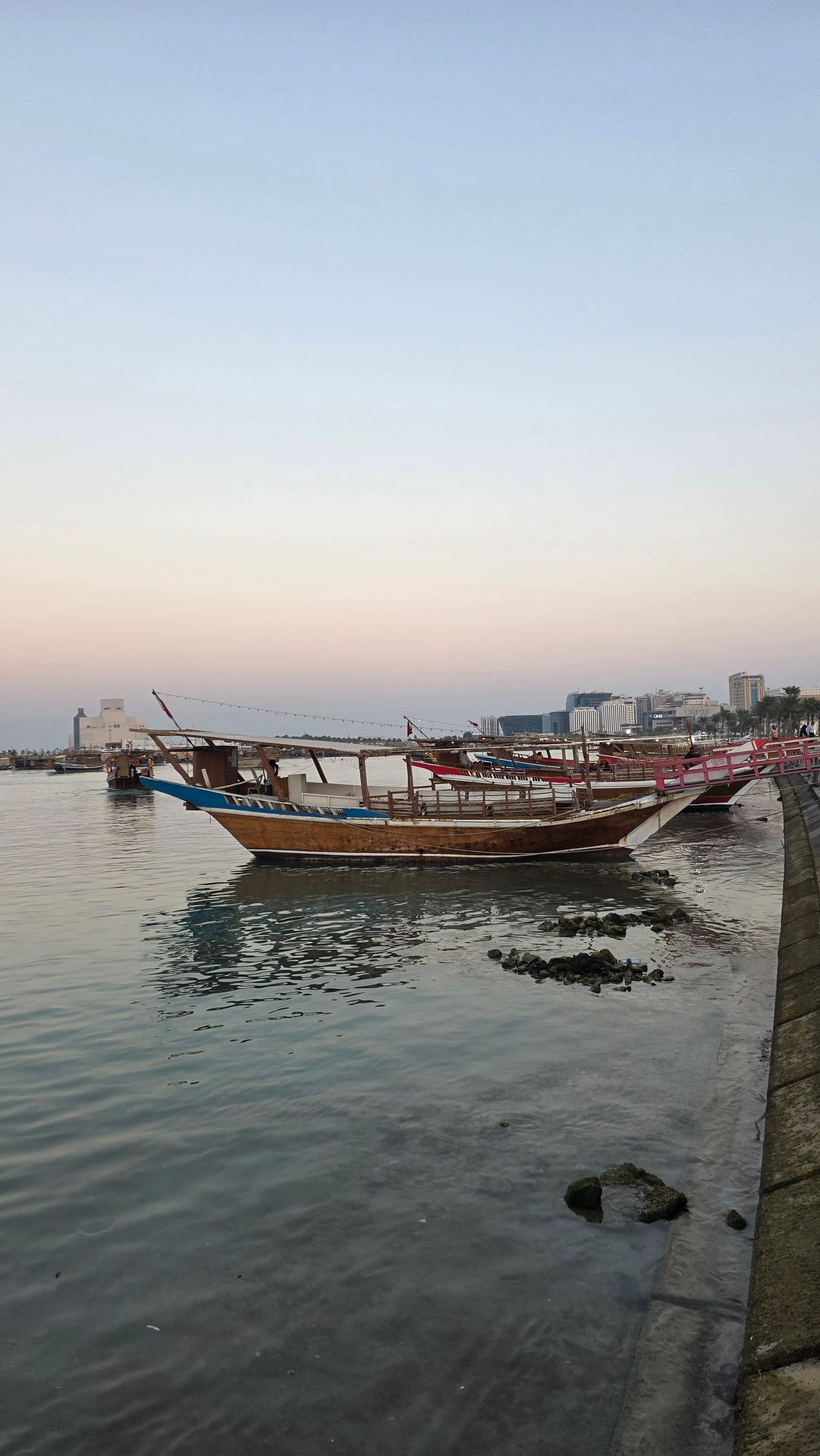
By the early 1900s, that inlet was crowded with boats of every kind. British official J.G. Lorimer recorded in 1908 that Doha’s inhabitants lived “by pearl-diving, sea fishing and a small maritime carrying trade.” He counted some 850 pearling boats and dozens of trading dhows, plying routes to Oman, Basra, the Persian coast and Bahrain. Pearls were literally Doha’s only export. An early traveller observed that “a long row of larger boats used in pearl diving testified to the importance of this enterprise. In the pearl season, the number of inhabitants here swells by thousands…”. It was a bustling scene: wooden vessels piled high with oysters, crews hauling nets at dawn, and the day’s first catches displayed in the souqs.
The Labor of the Deep
Before the 1930s and the subsequent discovery of oil, the pearl industry was the lifeblood of the Qatari economy, engaging nearly half of the entire population. This was an industry defined by extreme physical hardship, rigid social hierarchies, and a profound emotional toll on the families left behind on the shore. The pearling season was divided into specific periods, most notably the "Big Dive" (al-ghaws al-kabir), which lasted for four summer months between June and September. During this time, the coast would be nearly emptied of its male population, leaving the women to manage households and navigate the social and economic challenges of their absence.
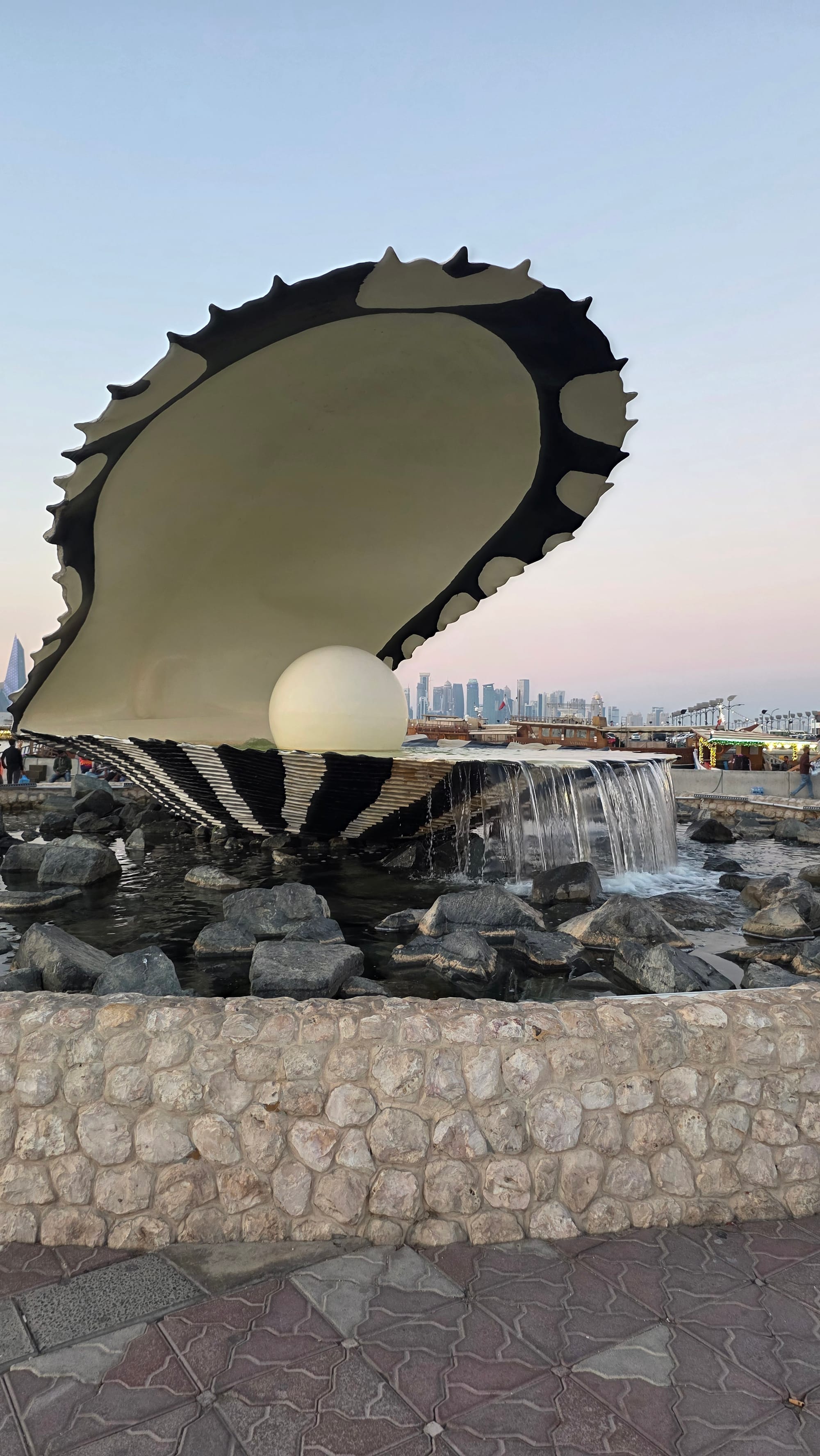
By the early modern era, Gulf pearls were world-renowned: Arab dhows carried Qatar’s oysters to India, Persia and Ottoman markets, and even Roman-era records hint that Gulf pearls were coveted in ancient trade routes. UNESCO notes that “in the 18th and 19th century, pearl trade was the main source of income in the Gulf region,” and that Al-Zubara (on today’s Qatari coast) was one of the key pearling ports.
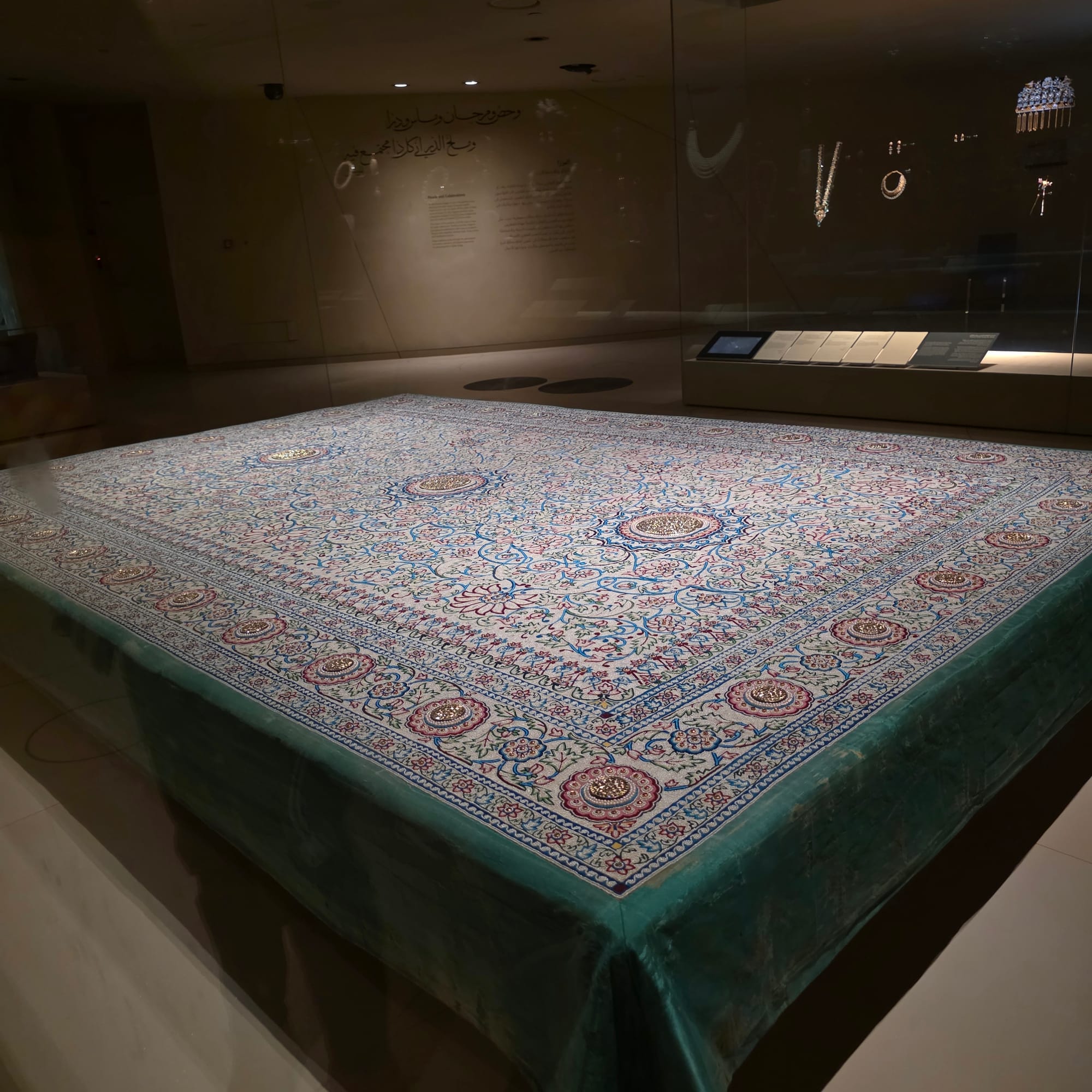
For about 200 years the pearl was Qatar’s “first export commodity”. In the late 1800s and early 1900s, pearls made up roughly three-quarters of the Gulf’s total exports. In 1907, almost half of Qatar’s 27,000 inhabitants earned their living from pearls. Each summer dozens of wooden dhows sailed north into the Gulf for months at a time. Diving men known as jazwas would hop on board and set out on voyages lasting 40–60 days or more. The life of a diver was one of grueling repetition and danger. A typical diver would perform between 60 and 100 dives in a single day, each lasting up to two minutes and reaching depths of up to 18 meters, or roughly 60 feet. The equipment was remarkably rudimentary, consisting of a nose clip (al-futam) made of bone or wood, a stone weight to facilitate a rapid descent, and a simple basket or net worn around the neck to collect oysters. The physical consequences of this labor were severe; divers frequently suffered from burst eardrums, chronic ear infections, and decompression sickness, colloquially known as "the bends".
The operations of a pearling vessel, or dhow, were governed by a strict hierarchy that mirrored the broader social structure of the Gulf. The boat captain, or nakhuda, was the central figure, often financing the voyage and taking significant portions of the profits, though he also carried the financial risk. Supporting the divers were the "pullers" or seebs, men who remained on the surface and were responsible for hauling the divers back to the ship upon a sharp tug of the rope.
This relationship was one of life and death; the seeb had to be constantly attentive to the diver's signal, as any delay could result in drowning. The economic structure of the voyage often kept crews in a cycle of debt, as advances were given to families before the season started, which then had to be repaid from the season's findings. Despite this, the arrival of a dana (a large, heavy, and perfectly round pearl) could change the fortunes of a crew and grant the diver a legacy that lasted for generations
The Rituals of the Aqueous World: Folklore and Sea Medicine
The inherent dangers of the sea fostered a culture of deep spirituality and folklore that remains a cornerstone of Qatari heritage. Because many of the afflictions suffered by divers; such as hallucinations from oxygen deprivation or the bends; were not medically understood in the pre-modern era, they were frequently attributed to the influence of evil spirits. Treatments for a sick diver often involved a blend of the practical and the ritualistic: the afflicted man might be covered with a sail and sat upon by his peers while they burned incense and recited verses from the Koran to drive out the spirits.
Folklore also provided a narrative framework for the sailors' relationship with the Gulf. Legends such as Bū Daryā, a half-man, half-fish monster that was said to terrorize sailors at night, served as cautionary tales about the unpredictable nature of the water. Another popular myth, May and Ghilân, credited the invention of the sail to a competition between two pearl fishers, illustrating how cultural innovations were often seen as products of the maritime struggle. These stories were not merely entertainment; they were shared during the long nights at sea or in coastal majlis gatherings, fostering a collective identity centered on resilience and faith.
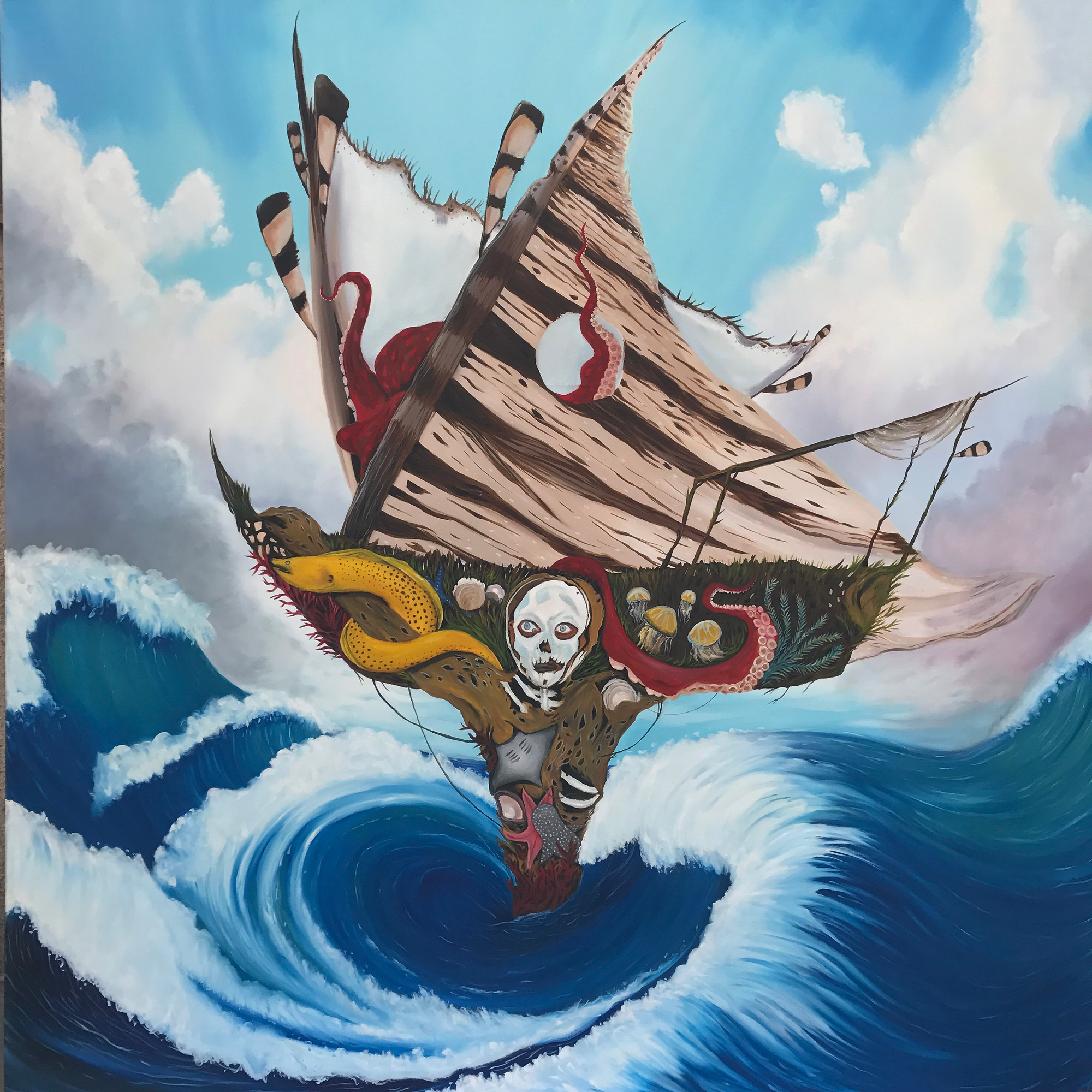
As the maritime economy that once defined life along the Gulf recedes into history, the voices of pearl divers live on in Fijiri; a collective genre of work songs born on long voyages and in the rhythm of tides. These songs, once inseparable from the dangers and discipline of the sea, now stand as living heritage: echoes of breath and labor woven into Qatar’s maritime memory, reminding us that the water that shaped Mina was never just a backdrop but a place where the body, the voice, and the sea were bound together in shared endurance and meaning.
Researcher Nasser Al-Taee gives his translation of Murshild bin Sa'd al-Bitali’s fijiri poetry into English:
They fight death and all its elements
While smiling
O how I suffer from the long nights
Witnessing those motherless divers
Every time a month passes by, another follows
Until the eyes grow old
Pearl Age and Decline.
The 1930s represented a tectonic shift for the Old Doha Port and the nation as a whole. Two simultaneous crises brought the pearling era to a definitive close: the global economic depression and the Japanese invention of cultured pearls by Mikimoto Kokichi. These cultured pearls were cheaper and more abundant, making the arduous harvest of natural pearls economically unviable almost overnight. As the pearling fleets shrank and coastal towns dwindled, Qatar faced a severe economic collapse.
However, this period of crisis was the precursor to the discovery of oil, which would provide the resources for the rapid modernization of Doha's infrastructure. Interestingly, museum narratives, such as those at the National Museum of Qatar, draw a parallel between the two industries: both relied on heavy physical labor, required men to be separated from their families for long periods, and were necessary for the survival of the community in a desert environment. The port, once the gateway for pearls, transitioned into a major trade lifeline for the country's growth, eventually hosting the customs house that managed the arrival of the goods required for a developing nation.
Shifting Tides: Oil and Modernization.
As pearling faded, oil transformed Qatar and its port. In December 1949 Qatar loaded its first crude shipment from Dukhan, heralding the oil era. Doha grew fast. By the 1960s, larger vessels needed deeper water than the original creek could offer. In 1970–71, Qatar contracted Japanese engineers to dredge the bay: a 3.5-mile channel 27 feet deep was cut through the coral bar. A new wharf was built and on January 18, 1971, Doha celebrated the opening of its first deepwater port. Massive freighters – carrying steel, cars, grain and, of course, oil equipment – could now tie up directly at Doha’s waterfront.
Water and the Everyday
Today’s Mina District invites you to stroll a promenade where once laden fishing nets must have dried. Cafés line the waterfront, outdoor tables framing views of a harbour that has been reimagined but still speaks of its past. Cruise ships docking at the Grand Terminal remind us that water continues to carry Doha beyond itself; in movement, in exchange, in looking outward while remembering inward.
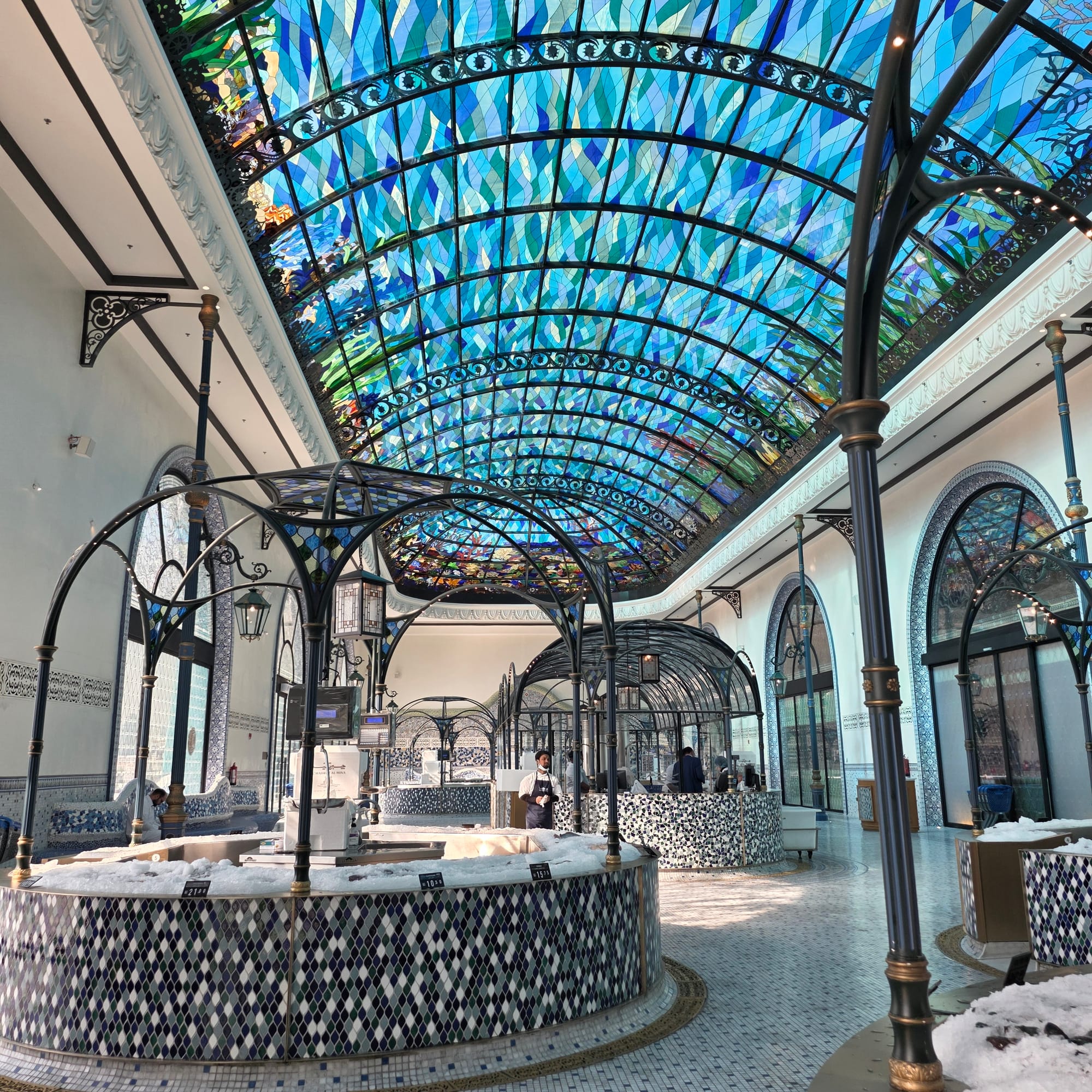
Along this quay is the Mina Fish Market, a fresh continuation of water-heritage. The display of marine life — from local fish to exotic sea treasures — echoes centuries of fishing practice that sustained families, nourished markets, and shaped societal bonds. In the hustle of market voices and the glint of freshly caught scales, the same sea that fed earlier generations still provides.
Imagining the Sea Through Art
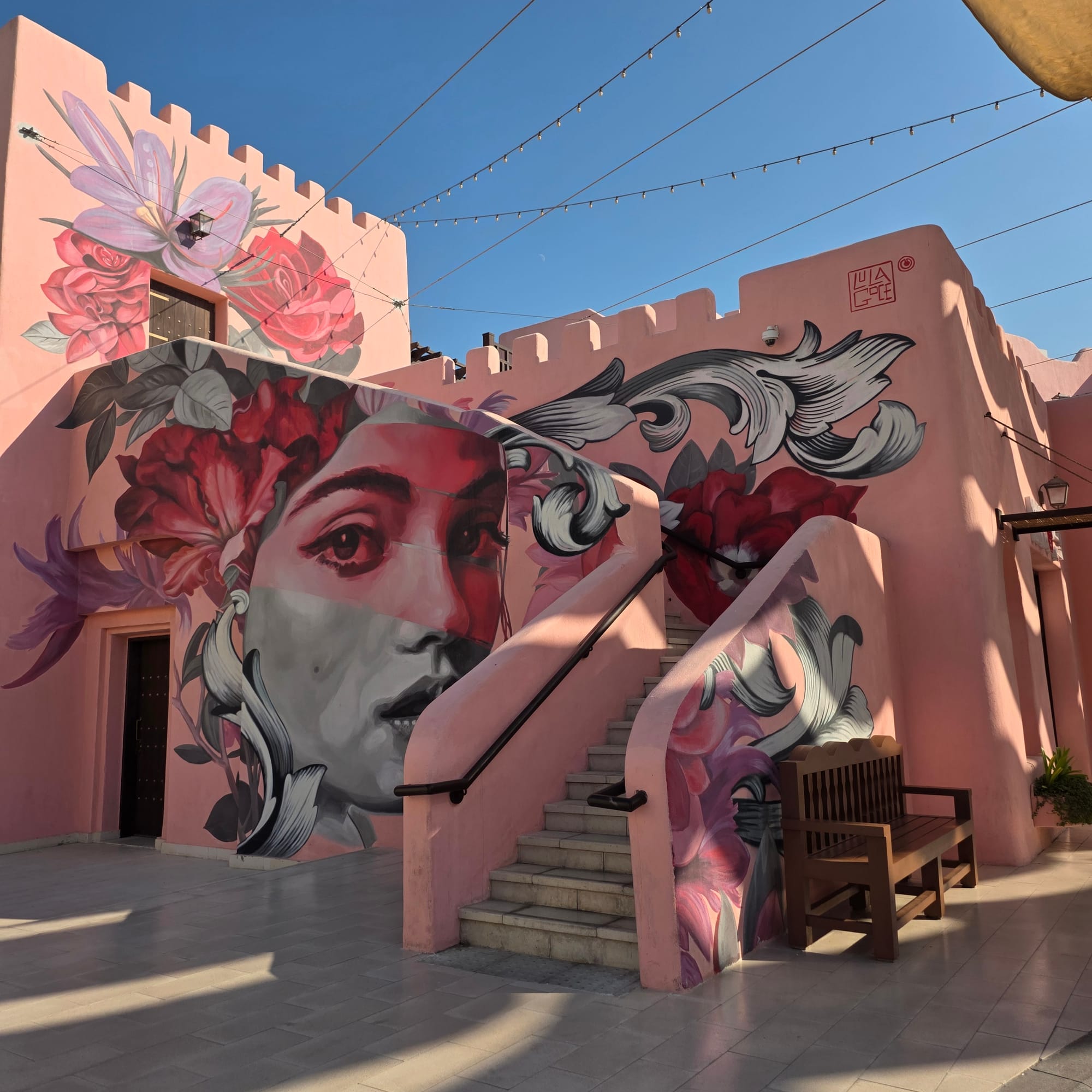
Murals across Mina’s walls, like the one featuring the girls and their kites, give form to the emotional language of water — the way it marries heritage with wonder. A ship-kite suggests departure and recall; a fish-kite suggests sustenance and belonging. What this mural holds; in gesture and colour; is an invitation to see the sea not only as geography, but as archive of feeling.
In this corner of Mina District, water becomes both motif and muse. It is the thread that connects:
- The earlier village whose people watched dhows slip over sandy bars,
- The fishing nets that once dried in the sun, and
- The kites of imagination held aloft by children who will inherit this shore.
Walking these cobbled paths, it is easy to see the sea twice over: once as a horizon of wind and salt, and again in the way it shapes every local story — spoken in stillness, reflected in every window, and carried in the collective life of Doha’s oldest harbour.
Through art and architecture, commerce and community, Mina District does not separate history from today; it makes water the space through which both are continuously understood. And in those pastel alleys, one finds that water is not only a physical presence, but also a living memory, still shaping how Doha sees its past and imagines its future.
This story is not about nostalgia. It is about continuity...
About a port that understands that history does not end...it flows.